5 min readPawel
The Customer Feedback Loop Is Product Management's Last Bottleneck
estimated read time: 6 minutes
Twenty years. Three companies. Same broken loop.
I've been in tech for 20 years. Started as a developer, moved into product management, then spent the last 13 years in go-to-market across SAP, Zoovu, and Alokai. I've seen this industry from both sides: building products and selling them.
One pattern has followed me the entire time. Companies collect more customer signal than ever. And act on less of it than ever.
Where Signal Goes to Die
Early in my career, I made a choice that surprised the people around me. I left the build side and moved to go-to-market. Not because I stopped caring about product. Because I wanted to understand what happened after the product shipped. I wanted to hear directly from the people using the things we built.
That choice put me in the room with customers for 13 years.
The proximity to real problems was addictive. Hearing a customer describe exactly what they needed in language no PRD would ever capture. The clarity that comes from sitting across the table from someone who's frustrated with your product and articulate enough to tell you why. That was the part I stayed for.
What kept frustrating me was watching that signal evaporate the moment it crossed back to the product team.
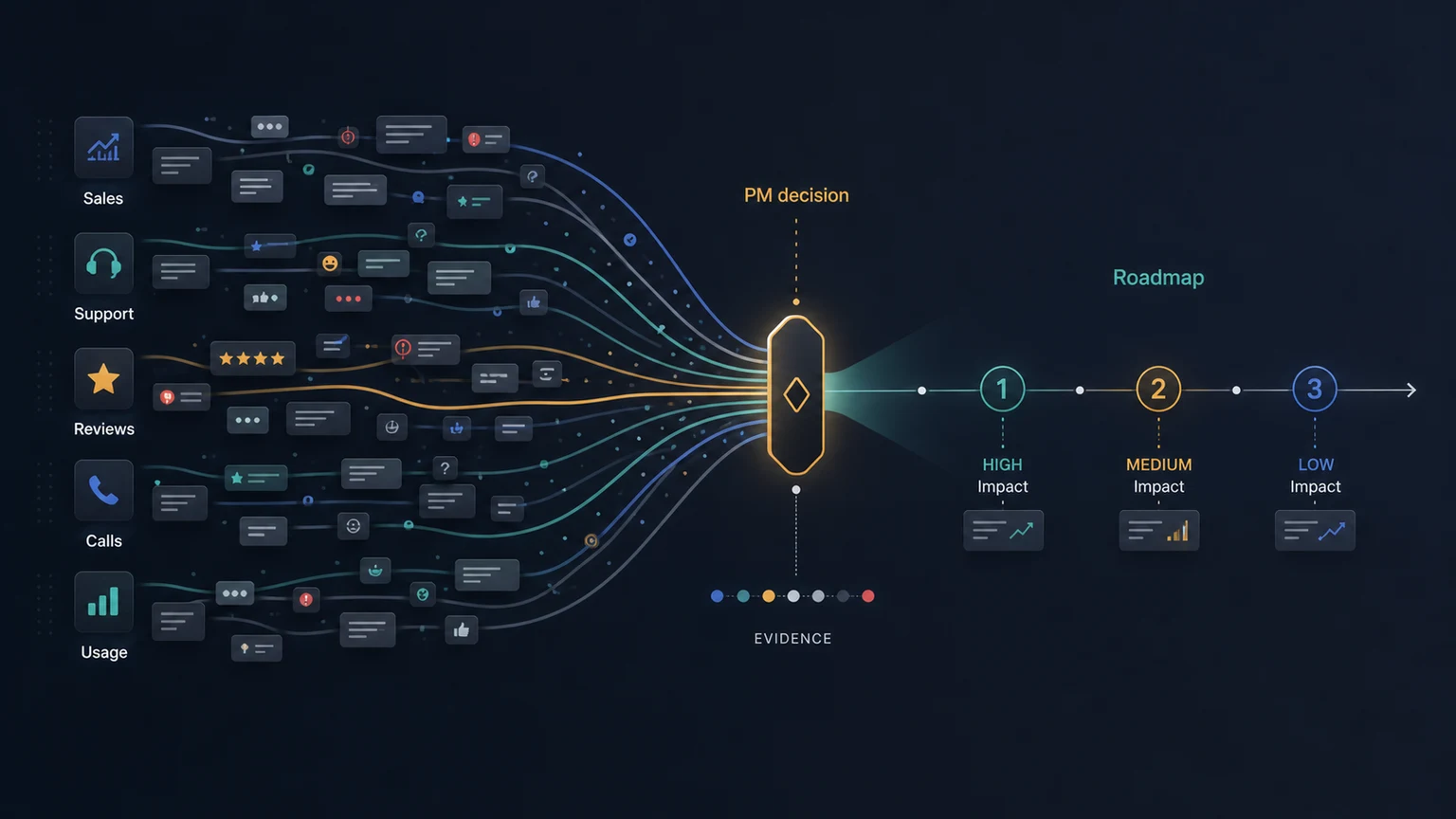
It wasn't that product teams didn't care. They cared deeply. The problem was structural. They had feedback pouring in from sales calls, support tickets, NPS surveys, advisory boards, community forums, partner channels. Every source was legitimate. Every source demanded attention. And no human team could synthesize all of it at the speed decisions needed to be made.
So they did what every overwhelmed team does. They triaged. They listened to the loudest voices. They relied on gut feel from the most senior PM in the room. The nuanced, contextual insight from actual customer conversations? Lost in a spreadsheet that nobody had time to read.
This wasn't a failure of intent. It was a failure of capacity.
Same Pattern. Three Companies. No Exceptions.
At SAP, I spent 11 years leading solution advisory teams globally, working with some of the largest enterprises in the world. These companies invested heavily in CX platforms. They had sophisticated tools to capture customer feedback. The tools worked. The ingestion didn't. Product teams at those enterprises were drowning in data they couldn't process fast enough to act on. Kantar Worldpanel puts a number on the downstream cost: 61% of new products fail within their first two years, primarily because companies didn't understand their customers well enough. I watched that play out from the inside, over and over.
At Zoovu, the angle shifted to product discovery. The platform generated rich behavioral data about how customers actually searched, compared, and chose products. You could see exactly where people got confused, what they compared, which attributes drove decisions. But product teams at Zoovu's clients rarely used that data to inform their own product roadmaps. The insight existed. The capacity to translate it into action didn't.
At Alokai, composable commerce gives product teams real freedom to build fast. The channels are connected. The feedback tools exist. But the gap between "signal collected" and "signal translated into a product decision" is as wide as it was a decade ago. The build side got faster. The decision side didn't.
Three companies. Three different slices of the software stack. The customer feedback loop broke in exactly the same place every time.
The Last Bottleneck Standing
AI removed the coding bottleneck. Tools like Cursor and Claude Code mean a single developer can ship what used to take a team of five. AI removed the content bottleneck. Marketing teams generate at scale. AI removed the analytics bottleneck. Dashboards practically write themselves.
Every bottleneck in the software value chain has been compressed or eliminated. Except one.
Understanding what customers actually need. And translating that understanding into the right product decisions.
That's the bottleneck that outlasted every other one. Not because it's harder technically. Because it requires something AI couldn't do until now: processing thousands of unstructured, contradictory, emotionally charged signals and surfacing the patterns that matter.
PMs spend roughly half their working week on this manual processing. Copying data between spreadsheets. Tagging tickets by hand. Searching for duplicates across channels. Fifteen to twenty hours of work that requires no human judgment, consuming the time that should go toward work that does.
G2 lists over 78 products in Enterprise Feedback Management and another 65+ in Feedback Analytics. That's 140+ tools designed to capture what customers are saying. The number designed to close the loop from customer signal to product decision? You can count them on one hand.
This isn't a process problem. You can't fix it with a better Notion template. The volume exceeded human capacity years ago.
Why I Stopped Watching
I spent 13 years on the GTM side watching this feedback gap widen. Then something clicked.
Product management is one of the roles most visibly reshaped by AI. Not replaced. Reshaped. The tedious parts — processing, categorizing, summarizing, deduplicating — are exactly what AI does best. The valuable parts — judgment, context, empathy, strategic tradeoffs — are exactly what humans do best.
That's why I moved back to product strategy at Alokai. And it's why I co-founded WingmanPM.
WingmanPM isn't another feedback collection tool. The world has enough of those. It's the system that closes the gap I watched widen for 20 years. AI processes the volume of customer signal that no human team can handle. It surfaces patterns, clusters themes, connects signals that arrived weeks apart in different formats. Then it puts that synthesized intelligence in front of a PM who can apply judgment, context, and taste to make the right call.
We call this feedback intelligence: not just collecting what customers say, but actually closing the loop from raw signal to product decision. It's the piece the category never built.
AI handles the processing. Humans make the decisions. The customer feedback loop that was broken for two decades finally closes.
I spent 20 years watching this problem from every angle. Developer. Product manager. Thirteen years in go-to-market. Now back in product strategy. I've seen the feedback gap from the build side, the sell side, and everywhere in between. Twenty years of flying blind on customer signal is enough.
I'm done watching.
Pawel Wiacek is VP of AI Strategy at Alokai and co-founder of WingmanPM. He spent 11 years at SAP leading global solution advisory teams and previously held roles at Zoovu and in product management.
Turn your own feedback into themes you can check against the source.