4 min readJuliusz
Something Fundamental Just Changed. Four of Us Saw the Same Thing
estimated read time: 6 minutes
Code is free. Decisions cost everything.
That's not a slogan. It's what happened to software in the last two years. AI coding agents write production features faster than any engineering team in history. Products that needed twenty engineers get scaffolded by three. The execution constraint that defined this industry for decades is gone.
We've each spent years in this world. Enterprise software. Product management. AI systems architecture. Go-to-market. When we looked at what this shift actually means, none of us saw an opportunity to build faster.
We saw a new way to crash.
Speed amplifies whatever direction you're pointed in. If you have a clear, continuous read on what your customers actually need, speed is an extraordinary advantage. You build the right things before competitors identify the problem.
But if you're flying on gut feel — on whoever argued loudest in last Thursday's planning meeting — speed just gets you to the wrong destination at Mach 2. When any team on earth can ship ten features this week, "fast" stops being the edge. "Right" does.
The companies that win the next decade of software won't execute fastest. They'll decide best.
That's the thesis we built WingmanPM around. Four of us arrived at it from four different directions.
Four vantage points, one structural gap
Pawel
I've watched this pattern repeat for twenty years across enterprise technology. At SAP, in pre-sales, inside organizations that spend millions on customer data and use almost none of it for product decisions. The math never worked: companies collect more signal than they can process, and the decisions they ship don't reflect what customers said. That was always expensive. Now that AI has collapsed every other bottleneck in the development cycle, it's the only bottleneck left. Organizations that build systematic capacity to turn signal into decisions will compound that advantage quarter over quarter. The rest will keep wondering why their roadmap misses.
Julek
What always bothered me wasn't the complexity of product decisions. It was the time burned before any decision even started. Reading. Copying. Tagging. Consolidating across six tools that don't talk to each other. Hours of work that required zero judgment and produced zero insight. Meanwhile the work that actually needs a human brain, the part where you understand what customers mean beneath what they say, spot which patterns matter, make the call when data is ambiguous, got whatever scraps of time were left. Usually none. I built WingmanPM to flip that ratio.
Oleh
I'm a developer. The interesting problem here isn't whether AI can cluster feedback. It can. The hard problem is building something product teams trust enough to stake real decisions on. That requires explainability at every layer. Every theme traceable to its source quotes. Every score with a rationale you can read. Every grouping auditable by someone who disagrees with it. We built WingmanPM's architecture around that principle from day one. Intelligence you can't interrogate isn't intelligence. It's a guess wearing a confidence score.
Daniel
The cost I've seen most consistently underestimated, across industries, across company sizes, is the compounding cost of product decisions made on incomplete information. Not the direct cost of shipping the wrong feature. The cascade after it: churn you didn't see forming, a segment you didn't understand until they left, an opportunity buried in signal nobody had time to read. What strikes me isn't that this gap exists. It's that the industry treats it as normal. As just how product development works. It's not normal. It's a structural failure, and it has a structural fix.
47 tools collect feedback. Zero close the loop.
Here's what nobody in the PM tool market wants to say out loud.
The category is full. Dozens of tools will help you collect customer feedback. Surveys. NPS widgets. In-app prompts. Support ticket aggregators. You can gather signal from every direction. Most product teams already do.
Then what?
Feedback sits in a spreadsheet. Someone tags it by hand when they find an hour. Themes get debated in a meeting where the loudest voice wins. Priorities get set by intuition dressed up as strategy. The customer who submitted the feedback never hears back. The loop stays open. Trust erodes. And next quarter, the team wonders why retention dipped.
Feedback intelligence is the practice of using AI to transform raw, unstructured customer feedback into prioritized product decisions — and then closing the loop from signal to shipment to "we heard you."
That second part is where everything falls apart. Collection without intelligence is noise management, not product management.
Now that AI coding has removed the speed governor, the cost of this gap compounds faster than ever. Teams can ship ten features this quarter. The question is whether any of them are the right ten. Without a feedback intelligence platform turning raw signal into evidence-backed priorities, speed becomes the most expensive line item in your stack. According to the State of Product Analytics 2025 report, only 15.7% of product teams use customer feedback as a primary data source, despite half of them relying on it to decide what to build. The signal is there. Nobody's reading it.
What we built, and why the loop is the whole point
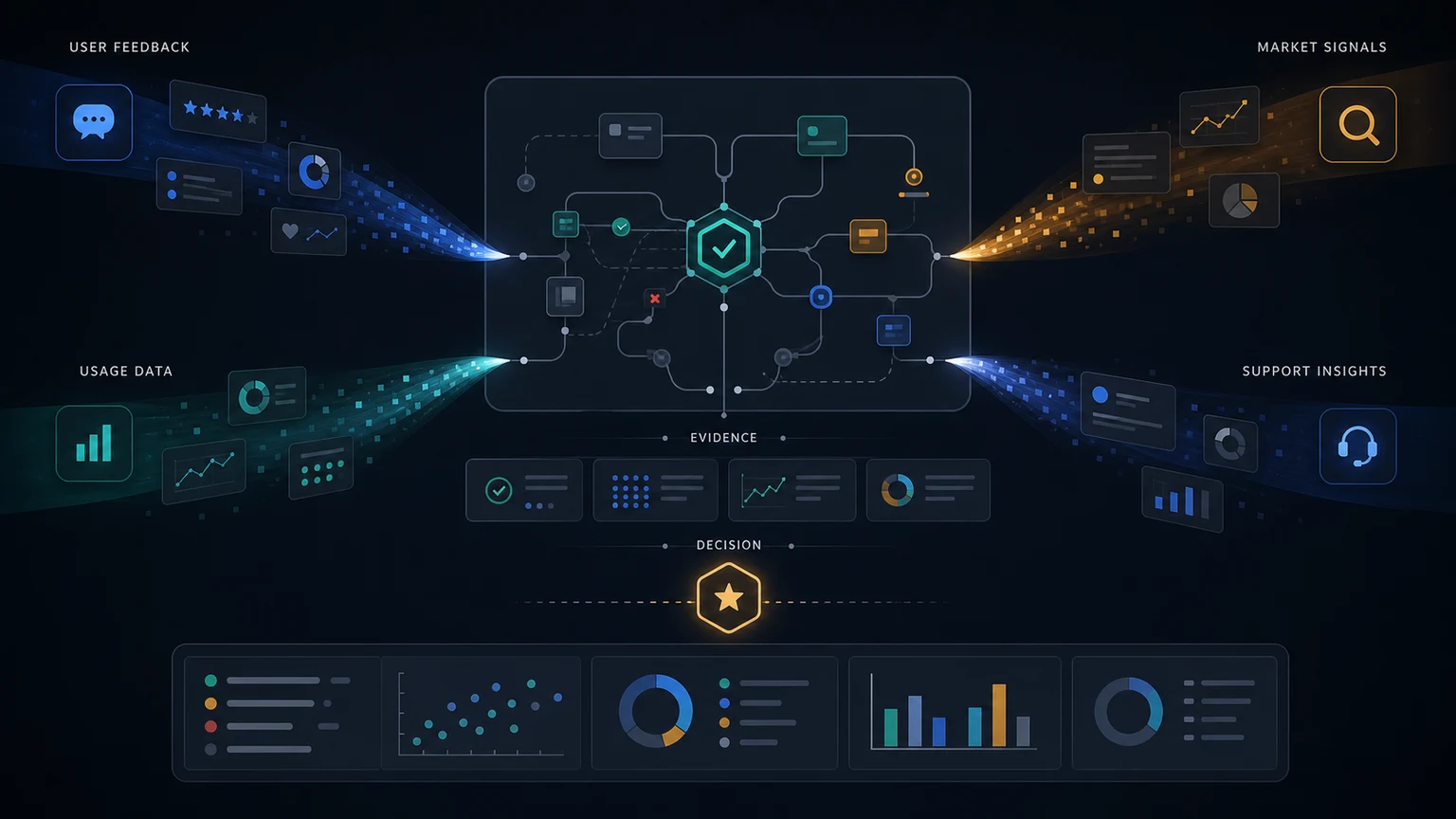
WingmanPM closes the loop most product organizations have left open. Raw, unstructured customer feedback goes in — spreadsheets, support tickets, email exports, integration feeds. Organized themes, evidence-backed priorities, and the deliverables engineering needs to act come out. The full cycle: signal to insight to decision to shipment to "we heard you."
Not as a one-time analysis. As a continuous pipeline. Because the customer feedback loop doesn't pause when you ship. It starts over.
We've written more about the thinking behind this. About what happens when code is cheap and taste is everything. About latent demand. About why closing the loop with customers is an act of respect, not a process checkbox.
That's in the manifesto.
Read: The Age of Taste — Why We're Building WingmanPM
If this describes the reality your team is living, we'd like to talk.
Request early access at wingman.pm
WingmanPM is built by AgenticForce.io, Warsaw. For product organizations navigating the shift from execution scarcity to feedback intelligence.
Turn your own feedback into themes you can check against the source.