5 min readPawel
Product Feedback Is Becoming a Decision System
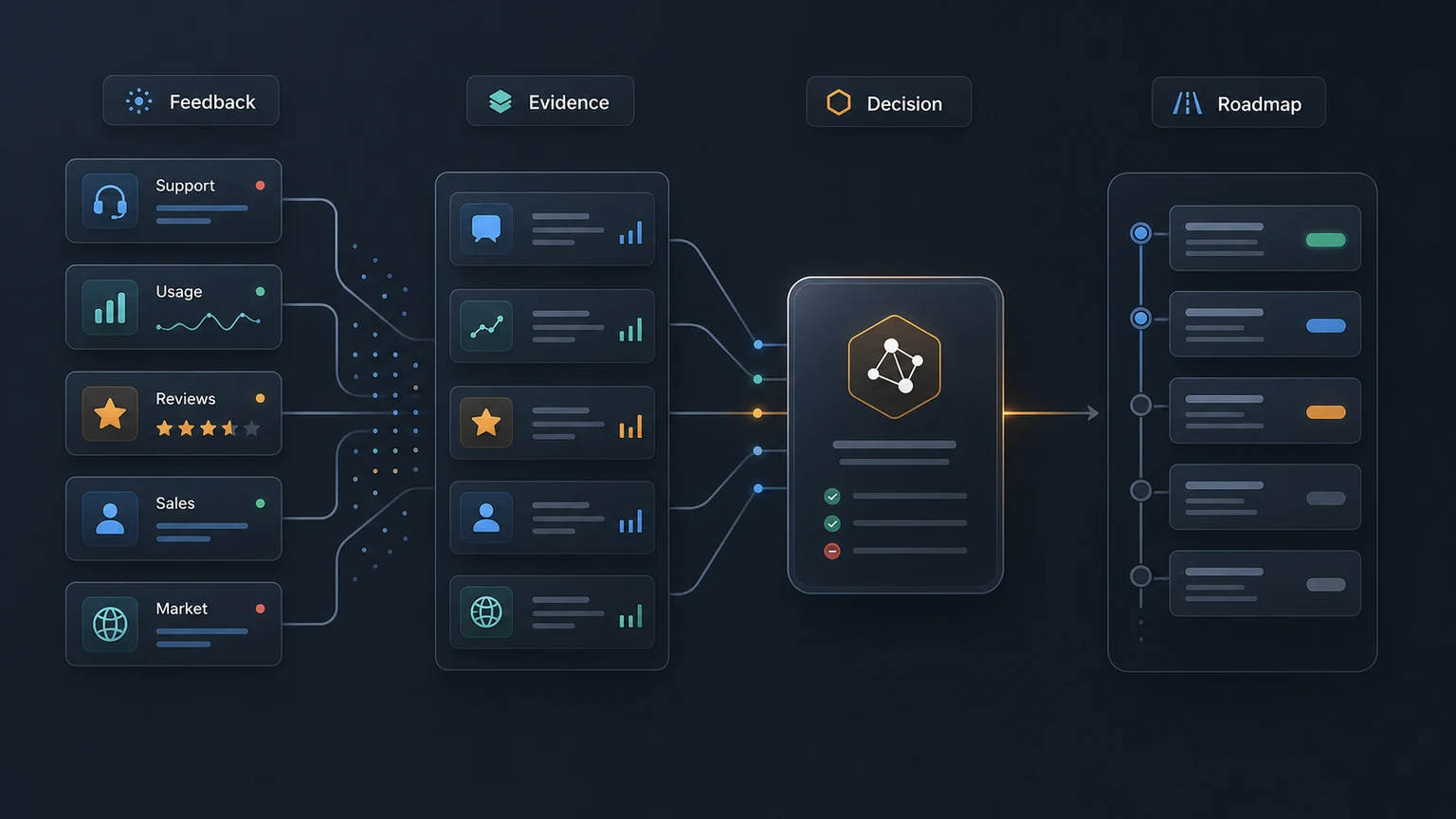
Customer feedback used to be a collection problem. Get more of it, centralize it, tag it, count it, put it somewhere the team can search later. That was the playbook for years, and it made sense. When engineering capacity was the constraint, a good PM had time to sit with the scattered mess of tickets, calls, interviews, Slack threads, reviews, and NPS comments, and turn it into a roadmap discussion.
That world is disappearing.
I have spent twenty years watching the cost of building software fall. Every time it drops, the same thing happens: the constraint moves. It used to be engineering. Now it is judgment.
AI has made software cheap to produce. Teams prototype faster, ship faster, and create more product surface than before. But feedback does not slow down because engineering sped up. It accelerates. More software means more users, more users mean more feedback, and PM capacity never scaled with the signal it is expected to understand.
So the next bottleneck in product management is not feedback collection. It is product comprehension.
The Industry Is Moving in the Right Direction
Linear's Customer Requests work is a useful signal for the whole category. Their team described a familiar pattern: users kept asking for "custom fields." A weaker process would have taken that literally and shipped exactly what was asked for. Linear looked underneath the request and found most of it was not about custom fields at all. It was about tracking customer needs and connecting them to product work.
That distinction is the job. Customers are good at describing pain. They are not always good at diagnosing the product system that should sit behind it. The request is one thing; the underlying need is another. Product management is not collecting requests, and it is not obeying them. It is interpreting them.
That is why the example matters beyond Linear. It shows the market moving past passive issue tracking. Feedback can no longer sit outside the workflow. It has to connect to issues, customers, segments, urgency, revenue context, and the engineering work that follows. For most teams, that alone is a real upgrade: a request linked to product work beats a request buried in a spreadsheet.
But it still is not the full loop. It tells you who asked for what. It does not preserve what the team believed, why they believed it, what tradeoff they made, and whether reality later proved them right.
That is the missing layer.
The Missing Layer Is Decision Memory
Every product carries a memory of decisions. Some teams keep it alive: they know what pain created a feature, what evidence supported it, which segment mattered, why one request was strategic and another was noise. Other teams lose it. They keep the feature but forget the reason, keep the issue but lose the signal, keep the roadmap item but forget the tradeoff. Six months later nobody can explain why something exists except by pointing to a planning meeting no one remembers clearly.
This is how products get heavy. Not through one dramatic mistake, but through hundreds of small decisions whose original evidence disappeared.
It matters more now because AI removes the old governor. Engineering bandwidth used to cap how much bad judgment could turn into shipped product. That cap is weaker now. When a team can build almost anything, the dangerous question is no longer "can we ship it?" It is "should this exist at all?" A feedback inbox cannot answer that. A decision system can.
The Reframe: Feedback Is Not a Backlog. It Is a Flight Recorder.
Most teams still treat feedback like a backlog of requests. That is the wrong mental model. A backlog is items waiting to be processed. Feedback is closer to a flight recorder: it should preserve what happened, what signal was visible, what the team understood at the time, which decision followed, and what reality said afterward.
The future of product feedback is not a better place to store requests. It is a system that remembers the reasoning chain from signal to decision. Raw signal comes in, themes emerge, evidence stays attached, the PM makes a judgment, that judgment becomes product work, the product ships, and the team checks whether the original pain actually changed. That is the signal-to-decision loop.
Once code gets cheap, the expensive part is not writing the feature. It is being wrong with confidence.
It is not a productivity trick. It is operating infrastructure for AI-era product teams.
What This Means for Product Teams
The best teams will still talk to customers, read tickets, run discovery, and use judgment. AI should not replace that. It should remove the synthesis tax around it. PMs should not spend half the week copying feedback between tools, tagging tickets by hand, hunting duplicates, and rewriting notes into summaries just to reach the point where a decision is possible. That is not product judgment. That is pre-work.
The real work is deciding what the signal means. Is this a retention problem or a usability problem? One loud account or an emerging pattern? Are customers describing the same pain in different words? What would have to be true for this to be worth building? Those are the questions that matter, and the tools around a PM should preserve the evidence behind them rather than flatten it into a list of top requests.
That is where WingmanPM is pointed. Not another place to collect feedback; teams already collect enough. The missing layer is helping teams turn scattered customer signals into themes, evidence, decision rationale, and product direction without losing the reasoning behind the work. Raw feedback in, decisions out, loop closed.
The Teams That Win Will Remember Why They Built
Everyone will build faster. The advantage will belong to teams that understand faster without flattening judgment: teams that preserve customer signal, challenge it, connect it to product work, and check whether reality confirmed the call.
That is a higher bar than feedback management. Feedback management asks what customers said. Product intelligence asks what we should believe, what we should build, and how we will know if we were right.
This is why the feedback loop is becoming a decision system. Not because PMs need another dashboard, but because the cost of a wrong product decision is rising exactly as the cost of acting on it falls. AI makes execution cheaper. It does not make judgment cheaper. It makes judgment more consequential.
So the question is no longer how to collect more feedback. It is how to build a product organization that reliably turns signal into better decisions. That is the next system worth building.
Turn your own feedback into themes you can check against the source.